
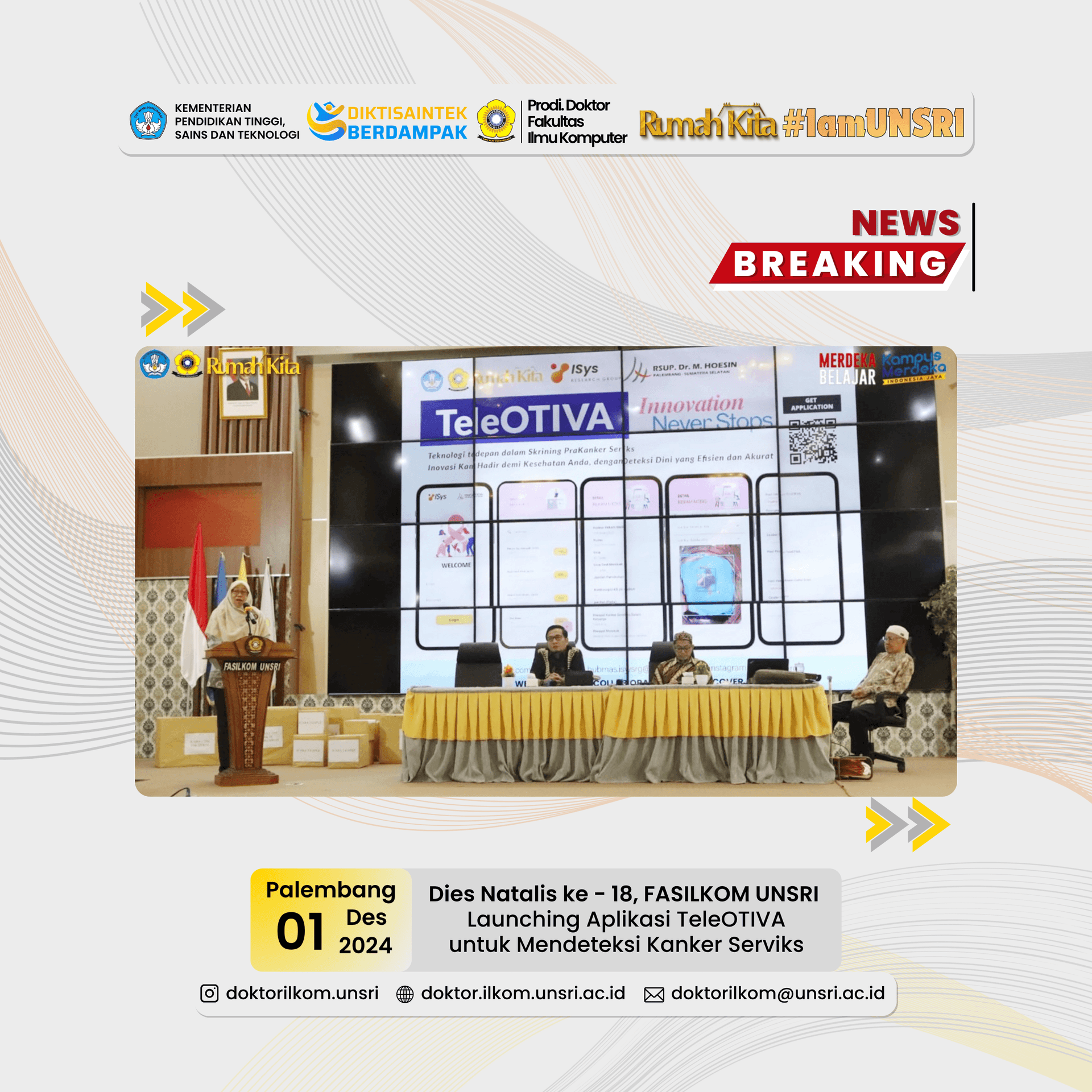
The Faculty of Computer Science at Sriwijaya University (Fasilkom Unsri) introduced the TeleOTIVA (Telemedicine and IVA Automation) application, which is capable of detecting cervical cancer. TeleOTIVA, a health technology innovation developed by the Intelligent Systems Research Group at Fasilkom Unsri, was launched in conjunction with the celebration of Fasilkom Unsri’s 18th anniversary, held in the Dr. Jaidan Jauhari, S.Pd., M.T. Hall 7th Floor, Fasilkom Unsri Training Building, Palembang Campus, Sunday (December 1, 2024).
In his remarks, the Dean of the Faculty of Computer Science, Prof. Dr. Erwin, S.Si., M.Si., fully supported the health technology innovation developed by the Intelligent Systems Research Group. “This product contributes to achieving Sustainable Development Goal 3 (Good Health and Well-being) through the early detection of cervical cancer, as well as Sustainable Development Goal 9 (Industry, Innovation, and Infrastructure) by providing affordable and sustainable health technology,” he said.
TeleOTIVA also received full support from the Rector of Unsri, Prof. Dr. Taufiq Marwa, S.E., M.Si. He noted that TeleOTIVA is tangible proof of Unsri’s commitment to advancing science and technology, particularly in the field of artificial intelligence (AI)-based healthcare. "By focusing on practical solutions to improve access to healthcare services, TeleOTIVA is expected to provide significant benefits to the community, especially in the early detection of diseases such as cervical cancer. TeleOTIVA’s key features include AI-based automatic interpretation of IVA results, an integrated telemedicine platform, high speed and accuracy, a user-friendly interface, and ease of integration with local healthcare systems. These features make TeleOTIVA an innovative solution for improving healthcare services, particularly in the early detection of precancerous cervical lesions. TeleOTIVA is now ready for commercialization as part of the support for Indonesia’s national action plan to eliminate cervical cancer. “Together with TeleOTIVA, let’s realize better healthcare services for women,” said the Rector.
Meanwhile, the Chair of the Intelligent Systems Research Group, Prof. Ir. Siti Nurmaini, M.T., Ph.D., explained that this innovative product is an artificial intelligence (AI)-based mobile application designed to assist medical personnel in automatically interpreting the results of cervical precancer screening through the acetic acid visual inspection (IVA) procedure. She has been conducting this research since 2019 in collaboration with the Gynecologic Oncology team at Dr. Mohammad Hoesin General Hospital in Palembang. “This app is integrated into a telemedicine platform to support faster, more accurate, and more affordable healthcare services using just a cell phone.
According to the data, Indonesia has the highest number of cervical cancer cases in Southeast Asia. Meanwhile, cervical precancer screening coverage is very low at only 7.3 percent of the 70 percent target. “This is one of the reasons we developed this innovation. We are concerned and want to address this issue through comprehensive research,” she said.
He further explained that the TeleOTIVA innovation is the result of a collaboration between researchers from the Faculty of Computer Science at Unsri and consulting physicians from the Division of Obstetrics, Gynecology, and Sub-Oncology at RSMH. “TeleOTIVA is capable of automatically analyzing IVA test results, providing quick and accurate interpretations to support medical professionals’ decision-making.
The TeleOTIVA application was tested directly on screening subjects at 17 Community Health Centers and RSMH Palembang in 2023. Currently, testing of TeleOTIVA is still ongoing, covering the regions of South Sumatra, Bangka, Lampung, and Jambi, with the primary goal of ensuring that the product is effective, safe, and can be widely implemented. “The testing involves hundreds of medical professionals—including oncology consultants, obstetrician-gynecologists, general practitioners, midwives, and nurses—as well as thousands of screening participants,” he explained.
His team believes TeleOTIVA can be a significant breakthrough in efforts to reduce cervical cancer incidence in Indonesia, particularly in areas with limited access to healthcare services. “TeleOTIVA is currently available on the Play Store. We hope it can reach more Indonesian women so they can undergo early screening easily and accurately,” he concluded.
On the same day, as part of the 18th Anniversary of the Unsri Faculty of Computer Science, the “Masem Pedes” event was also held (a forum on the welfare of Fasilkom Unsri staff and faculty). On this occasion, the dean treated the Fasilkom Unsri academic community to 18 types of dishes, including lakso, burgo, celimpungan, laksan, pempek kapal selam, pempek kulit, fruit salad, fruit ice, bubur sumsum, ragit, ketan glodo, wheat-based dessert, fish-based dessert, tekwan, red bean porridge, surabi, and banana-taro kolak.