
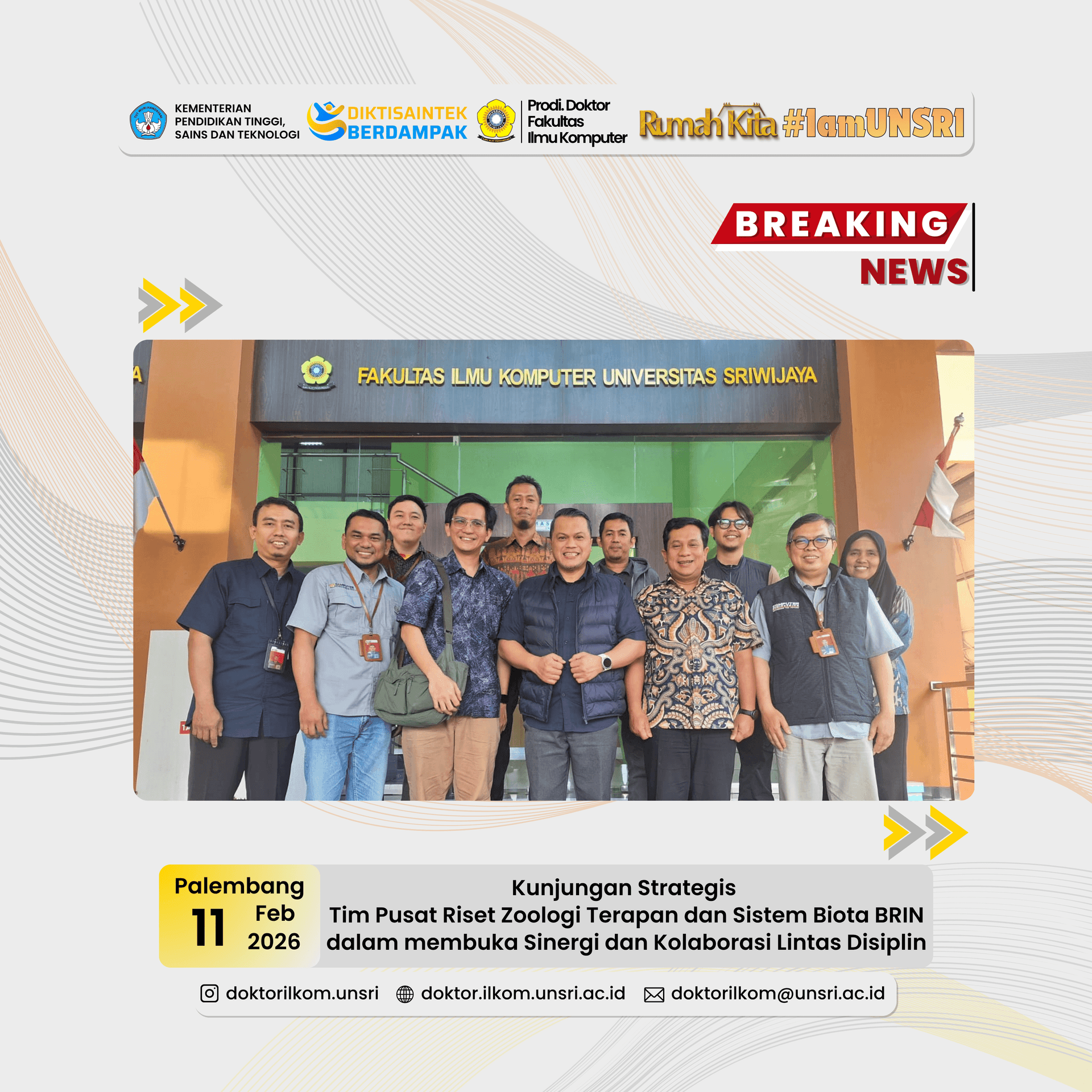
The COMNETS-SPCIES Research Group at the Faculty of Computer Science, Sriwijaya University (UNSRI), and the Fisheries Research Center of the National Research and Innovation Agency (BRIN) are strengthening their research collaboration in the field of smart fisheries. The meeting, held at the UNSRI Faculty of Computer Science campus in Palembang, on Friday (February 13, 2026), resulted in plans for flagship research collaborations and a roadmap for the development of smart fisheries in Indonesia, combining expertise in pervasive systems and intelligent systems with biological resource management.
This collaboration involves two research centers under BRIN’s Biological and Environmental Research Organization: the Center for Biota Systems Research (PRSB), which focuses on the conservation and utilization of biological resources, and the Center for Applied Zoology (PRZT), which specializes in innovations in fauna, production technology, and bioprospecting.
Two research agendas have been identified as priorities in this collaboration: the conservation of the Belida fish (Chilata lopis), an iconic species of South Sumatra that is now protected. Using an embedded image processing approach, the research team will develop artificial intelligence (AI) to automatically and non-invasively detect spawning patterns.
“The Belida fish (Chilata lopis) has specific and sensitive spawning characteristics. With embedded visual sensor technology, we can automatically detect reproductive patterns without making physical contact that could stress the fish. In fact, we not only monitor but also gain a deep understanding of the biota’s behavior without disturbing its natural habitat. Embedded Vision and processing technology enables real-time data processing directly on-site (edge computing),” said one of the COMNETS researchers alongside researchers from BRIN.
Support from the Biota Systems Research Center (PRSB)—a unit focused on the sustainable management and utilization of biological resources—is key, as PRSB is tasked with ensuring that the applied technology remains aligned with nature conservation principles.
In addition to conservation, this collaboration also targets the food sector through the optimization of the Mina-Padi smart farming system. Whereas existing technology has so far been limited to monitoring, it has now been upgraded to an automated control system. This smart system will eventually be capable of making autonomous decisions to precisely regulate environmental parameters—such as water flow, nutrient levels, and temperature—to ensure maximum crop yields. The Center for Applied Zoology Research (PRZT) plays a crucial role in providing baseline data on the needs of aquatic fauna (fish) within the Mina-Padi system, ranging from reproductive technologies to effective feed management to support the local economy.
Professor Deris Stiawan, a professor at the UNSRI Faculty of Computer Science, emphasized the importance of a legal framework and data ethics in this research. He urged that this collaboration be formally enshrined in a cooperation agreement (PKS) to strengthen its institutional legitimacy. “This collaboration must not be limited to technical aspects alone. A strong legal framework is needed—for example, through a Cooperation Agreement (PKS)—so that this partnership has clear institutional legitimacy,” he said.
Furthermore, Prof. Deris stated that research data management will be conducted jointly and transparently. “The research datasets will be jointly managed and published through open science platforms such as Zenodo, IEEE Dataport, or—once a joint community is established within a center of excellence—stored on a public cloud, so they can be accessed by the global scientific community. This aligns with the principles of transparency and openness in science,” he added.
The discussion was dynamic and demonstrated the synergy of expertise between the fields of computational technology and life sciences. The meeting was also attended by expert researchers from BRIN who brought multidisciplinary perspectives, namely Dr. Arif Wibowo, S.P., M.Si. (Principal Researcher, Biota Systems Research Program), Dr. Deni Radona, S.Pi., M.Si. (Associate Researcher, Applied Zoology Research Program), Dr. Reza Samsudin, S.Pi., M.Si. (Junior Researcher, Applied Zoology Research Program), Dr. Boby Muslimin (Senior Researcher, Applied Zoology Research Program), and Mirna Dwirastina (Senior Researcher, Biota Systems Research Program).
Also in attendance were researchers from the Faculty of Computer Science specializing in Edge Computing, namely Dr. Ahmad Zarkasi (Computer Engineering program), Dr. Kemahyanto Exsaudi (Computer Engineering program), Huda Ubaya. MT (Department of Computer Systems), Aditya Putra Perdana Prasetyo, S.Kom., M.T. (Computer Engineering program).
Dr. Arif Wibowo emphasized that information integration is crucial for PRSB in managing and conserving biological resources. Meanwhile, the applied zoology team sees significant opportunities in the development of animal feed and reproduction technologies, supported by data efficiency from the scientific groups with expertise within the Faculty of Computer Science at UNSRI.
In addition to product innovation, this collaboration also opens opportunities for student participation through impactful internship programs and the development of final projects based on real-world initiatives at BRIN. This initiative is expected to foster a sustainable research ecosystem while cultivating young talent in the field of fisheries technology.
As a long-term follow-up, both institutions agreed to promote the establishment of a Collaborative Research Center (PRK) as a strategic research hub between UNSRI and BRIN in the future, which will generate innovations that support the local economy, ecological health, and national food sovereignty.